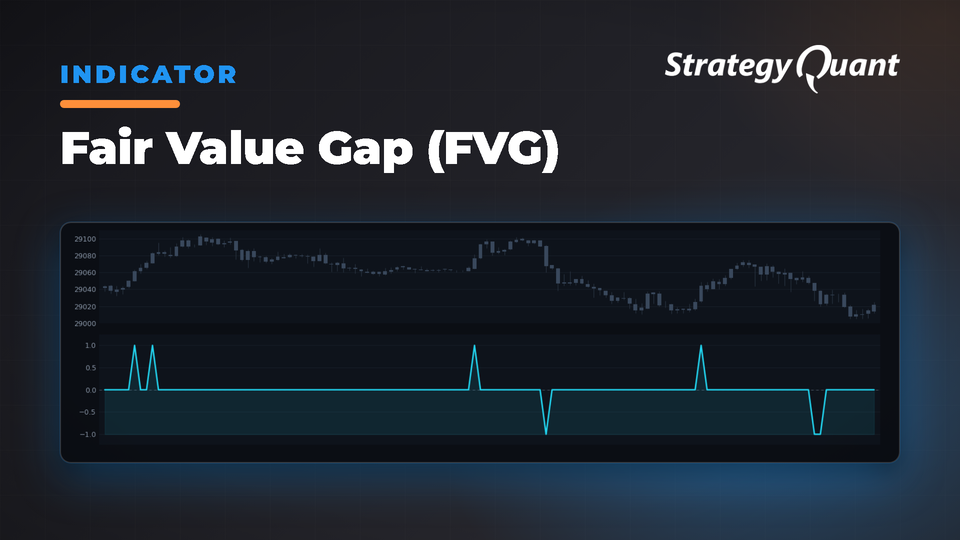
Identifies Fair Value Gaps—price zones skipped during institutional moves—to locate support/resistance levels and trading opportunities when price returns to fill these gaps.
Smart money institutions understand that markets naturally seek equilibrium. When their large orders create imbalances by moving price too quickly, they know the market will likely return to these levels eventually. The Fair Value Gap indicator helps retail traders identify these institutional footprints and anticipate where price might return to establish true fair value.
Understanding Fair Value Gaps: A Step-by-Step Breakdown
Fair Value Gaps form when urgent institutional activity creates such strong directional pressure that entire price ranges get skipped. With three consecutive candles: the first establishes a range, the middle candle shows strong directional movement (the institutional "push"), and the third continues in the same direction leaving a gap. The gap occurs when the current candle's extreme doesn't overlap with the price range from two periods ago.
Bullish Fair Value Gap: Aggressive institutional buying pushes prices up quickly, creating a gap where the current low is higher than the high from two bars ago. This gap represents prices where no selling occurred – an imbalance that attracts future selling interest.
Bearish Fair Value Gap: Aggressive institutional selling creates downward gaps where the current high is lower than the low from two bars ago. This gap represents prices where no buying occurred – an imbalance that attracts future buying interest.
Why the MinCandleSize Parameter Matters
The MinCandleSize parameter is a quality filter that separates genuine institutional moves from market noise. It requires the current candle to be substantially larger than surrounding candles before qualifying as a Fair Value Gap. When MinCandleSize is set to 1.5, the current candle must be at least 50% larger than both the left and right candles. Higher values demand even more dramatic size differences, filtering for only the most significant institutional moves.
Parameters & Configurations
MinCandleSize (Default: 1.5) – This multiplier determines how much larger the current candle must be compared to surrounding candles. Range: 1.0-10.0. Lower values catch more gaps but include more noise, while higher values focus only on the most dramatic institutional moves.
• Standard Setup: MinCandleSize = 1.5 (balanced approach)
• Conservative Setup: MinCandleSize = 2.0 (most dramatic institutional imbalances)
Trading Applications
Gap Fill Trading: Gaps represent prices where proper price discovery never occurred. The market often returns to establish fair value in that range.
Reversal Zone Identification: Fair Value Gaps often act as significant support and resistance levels. Bullish FVGs provide support during pullbacks in uptrends, while bearish FVGs provide resistance during retracements in downtrends.
Institutional Footprint Analysis: Clusters of Fair Value Gaps in a particular direction indicate sustained institutional positioning.
Best Practices for FVG Analysis
Consider the timeframe you're analyzing – higher timeframe FVGs carry more weight. FVGs created during high-impact news events or around key market levels tend to be more significant. Combine Fair Value Gap analysis with broader market structure understanding. Volume analysis adds confirmation: gaps accompanied by unusually high volume suggest more urgent institutional activity and lead to more reliable fills.
Indicator Availability:
This indicator is implemented for MT4, MT5, TradeStation, and MultiCharts.
Using Custom Blocks for Conditions:
You can easily define your own conditions in StrategyQuant X using Custom Blocks. For more detailed information, refer to the following resources:
• StrategyQuant Documentation: Custom Blocks
• StrategyQuant Documentation: Strategy Templates & Custom Blocks
• StrategyQuant YouTube Tutorial: Custom Blocks Overview
Importing Custom Indicators into SQX:
To import custom indicators into StrategyQuant X, follow the step-by-step instructions provided here:
Import & Export Custom Indicators and Other Snippets
You know me as clonex. I'm Ivan Hudec — I built the free blocks you're using here, and I write about the research behind them at algotrading.space. Need something built? Work with me.