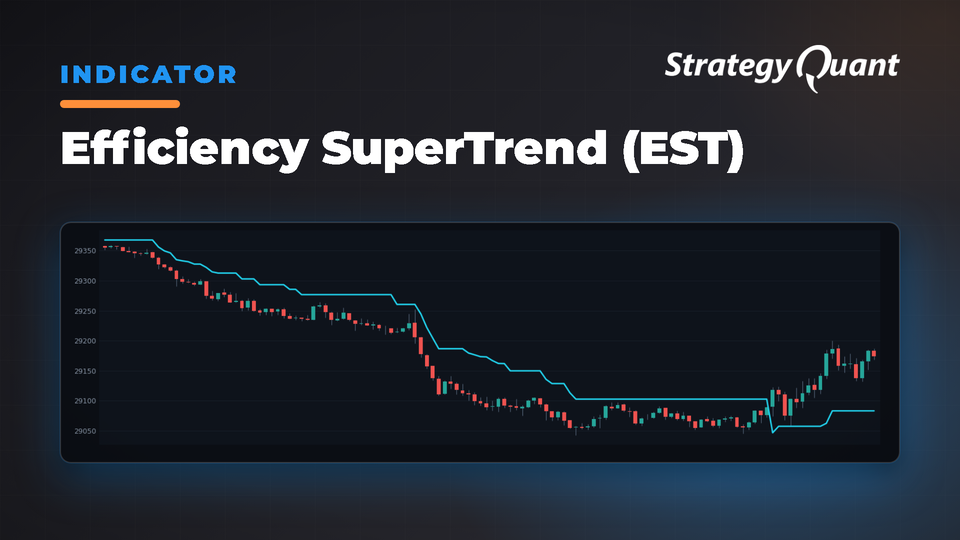
Combines SuperTrend with efficiency ratio measurement to freeze signals during choppy markets. Eliminates false signals and whipsaws by updating trends only when price moves directionally.
Efficiency SuperTrend
This indicator measures market efficiency by comparing net directional movement to total price path traveled. When markets trend, the Efficiency Ratio approaches 1.0; during choppy conditions, it drops toward 0.0. By requiring a minimum efficiency threshold before updating trend signals, it reduces false signals in ranging markets.
How It Works
The indicator combines SuperTrend logic with efficiency measurement. It calculates the Efficiency Ratio by dividing absolute net price change by the sum of all bar-to-bar changes over a lookback period. When efficiency drops below threshold, the SuperTrend value freezes at the previous bar's level, preventing whipsaws. Only when efficiency rises above threshold does normal SuperTrend calculation resume.
Core Logic: SuperTrend calculates upper/lower bands based on midpoint ±(ATR × multiplier). Price above/below the line determines trend direction. The key innovation: when Efficiency Ratio falls below threshold, the indicator freezes its value, filtering ranging noise while capturing genuine trend changes.
Parameters
ATRPeriod (Default: 14) – Lookback period for Average True Range (Range: 2-240). Shorter periods are more responsive; longer periods are smoother.
ATRMult (Default: 3.0) – Multiplier for ATR when calculating band distance (Range: 0.5-10.0). Lower values generate more frequent signals; higher values reduce frequency and increase reliability.
EfficiencyPeriod (Default: 14) – Lookback period for Efficiency Ratio (Range: 2-240). Generally align with ATRPeriod. Shorter periods are more responsive; longer periods provide more stable assessment.
EfficiencyThreshold (Default: 0.30) – Minimum Efficiency Ratio required for SuperTrend update (Range: 0.0-1.0). Values 0.25-0.35 work for most markets. Lower thresholds allow more updates; higher thresholds maximize whipsaw reduction.
Preset Configurations
Standard Balanced: ATRPeriod=14, ATRMult=3.0, EfficiencyPeriod=14, EfficiencyThreshold=0.30 — suitable for most markets and timeframes.
Conservative Tight Filter: ATRPeriod=20, ATRMult=3.5, EfficiencyPeriod=20, EfficiencyThreshold=0.35 — for volatile or choppy markets.
Responsive Setup: ATRPeriod=10, ATRMult=2.5, EfficiencyPeriod=10, EfficiencyThreshold=0.25 — for trending markets or shorter timeframes.
Usage & Best Practices
Enter when price clearly establishes above the SuperTrend line with efficiency above threshold. Strongest entries occur when price breaks through the line with significant efficiency spike. Manage positions conservatively during frozen periods (low efficiency); re-engage when efficiency returns.
Match ATRPeriod and EfficiencyPeriod to your trading timeframe. For intraday trading: 10-14 bars. For swing trading: 14-20 bars. Adjust EfficiencyThreshold based on market behavior—trending markets work well at 0.25; choppy markets benefit from 0.35+.
Implement risk management with stops beyond the SuperTrend line. During high-efficiency trending, use tighter stops. During marginal efficiency, use wider stops. Position size should reflect signal quality, taking larger positions when efficiency is substantially above threshold.
You know me as clonex. I'm Ivan Hudec — I built the free blocks you're using here, and I write about the research behind them at algotrading.space. Need something built? Work with me.